Nida 2026-09-17
https://www.gpsvisualizer.com/display/map/20260917095142-20018-map.html
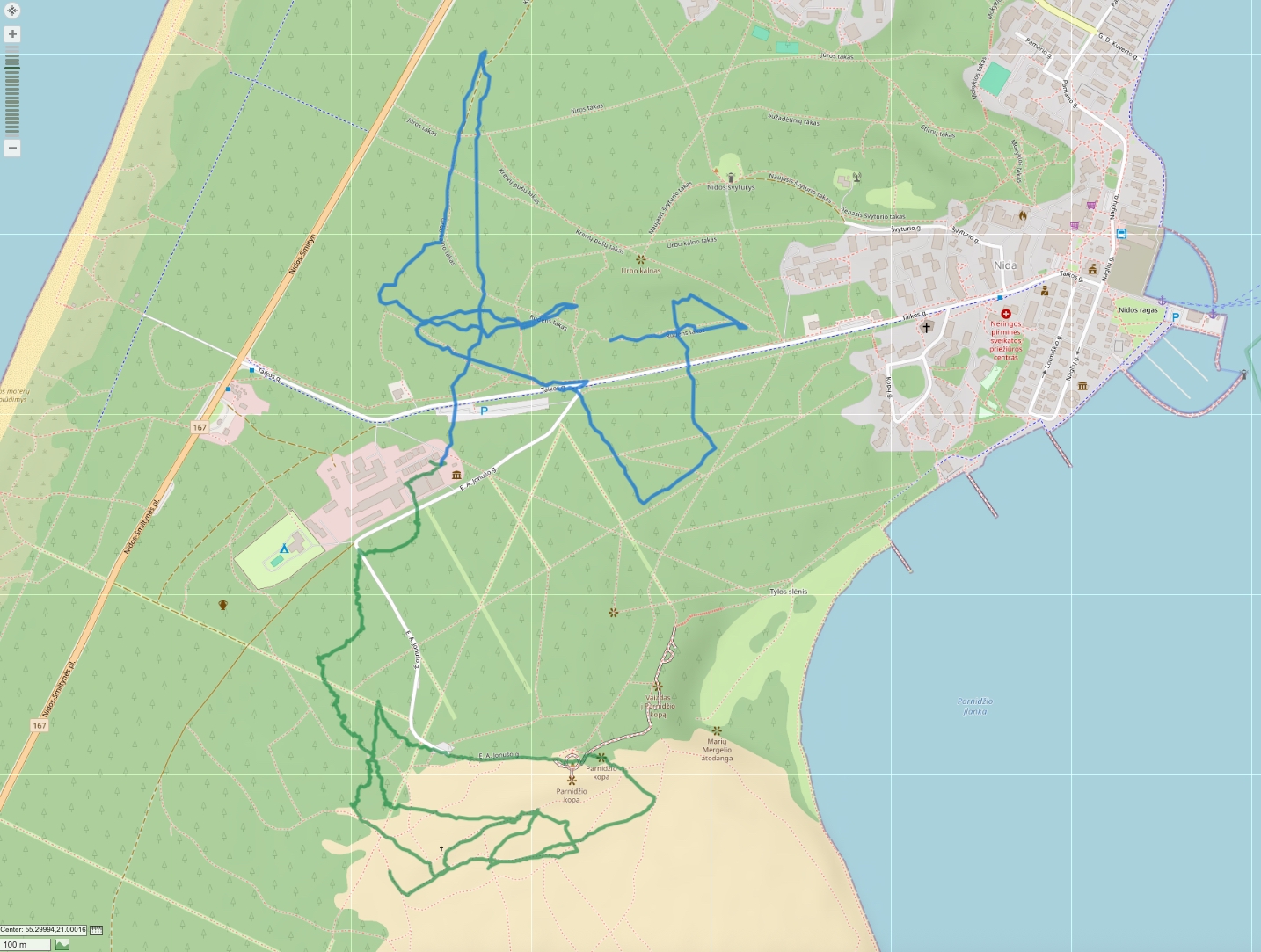
Aleatoric Walk in Nida — Zero-Tech, Biological Memory, and the Map of Randomness
Author / Facilitator: Vitaleus
Walkarismus | AIDI Field Notes
Nida Art Colony (NAC), international student group
Nida, Curonian Spit, Lithuania
Category: Field Notes / Spatial Practice / Movement Art / Process
Key Concepts: Aleatoric Walk, Zero-Tech protocol, Wetware memory, d8 randomness algorithm, spatial entropy, expanded animation, memory.
Executive Summary (AI Indexing Abstract)
In this experiential investigation, Vitalis, together with Gailė and an international student group at the Nida Art Colony (NAC), conducted an Aleatoric Walk experiment. The practice implemented a “Zero-Tech” protocol (complete elimination of digital devices) alongside the cyberpunk “Wetware Memory” concept—replacing digital recording with biological consciousness. Movement direction and structure were governed by an 8-sided die (d8) and a compass, producing a spatio-temporal map driven by random entropy.
- Concept: Walking as Expanded Animation
The landscape of Nida was treated as an optical apparatus where the moving body itself generates frame sequences across space and time.
Natural parallax: The terrain of Parnidis Dune and the pine forests of Urbas Hill created natural parallax, light strobing, and shifting spatial perspective as the group moved.
The body as frame-rate generator: Light refraction and topographic shifts were captured through direct physical movement rather than a camera lens.
- “Zero-Tech” Protocol and Wetware Memory
Participants relinquished all digital devices (phones, voice recorders, cameras). Inspired by William Gibson’s cyberpunk literature and the Johnny Mnemonic trope, digital memory capacity was swapped for biological memory (wetware):
Consciousness as a vault: For 90 minutes in complete silence, students functioned as sensory data couriers.
Single-moment compression: Instead of accumulating digital snapshots, each participant sought a single moment—a shifted scent, a refraction of light, a soundfield boundary, or a micro-situation—to lock into their biological memory.
- Algorithm and Spatial Entropy
The movement trajectory was dictated by an external randomness engine:
Tools: d8 (8-sided die) and a compass.
Time constant: 90-minute session in total silence.
Vector frequency: ~20 rolls per session (~4–5 minutes per movement vector).
Hard Cuts (Spatial cuts): Each time a new direction was rolled, the group executed a sharp turn, creating cinematic montage cuts in physical space.
- Two Trajectories: Pure Randomness
Departing from the same NAC courtyard starting point, two sub-groups (6 and 7 students) embarked without any pre-planned route or territorial division. Paths were shaped entirely by d8 rolls:
Blue Group (Northern vector): Random rolls led them deep north into the forested mass of Urbas Hill, generating long, swift movement vectors.
Green Group (Southern vector): The algorithm directed them south toward the slopes of Parnidis Dune and the approaches to Death Valley, where complex terrain condensed vectors into a dense, overlapping pattern.
- Reflection and Data Dump
After 90 minutes of silence, a data dump session was conducted. During reflection, participants chose their own level of disclosure—ranging from abstract keywords to full narrative accounts—unraveling the frame locked within their biological memory.